
Ferhat Kacmaz, HUNDREDHANDS, and the Key Legal Question in a Workplace Powered by Digital Employees
A digital employee processes customer inquiries overnight. It searches emails, accesses company data, prepares a quotation, and initiates the next step in a business process. The following morning, something has gone wrong.
The price was incorrect. Confidential information was used. A message was sent to the wrong recipient. Perhaps the system even prepared a decision that placed someone at an economic disadvantage. Who bears responsibility?
The business owner? The provider of the digital employee? The developer of the underlying artificial intelligence model? Or several parties at the same time? This question will determine whether powerful AI systems can eventually become trustworthy business infrastructure. For Ferhat Kacmaz and HUNDREDHANDS, the issue is particularly important. Kacmaz deliberately positions his technology as more than an occasionally used chatbot. HUNDREDHANDS is designed to integrate digital employees into real business processes.
The closer artificial intelligence moves toward customers, contracts, invoices, and business decisions, the more important control and legal accountability become. Kacmaz captures this issue of trust with a simple example. An explanation such as „It’s somewhere in the cloud“ is hardly sufficient to inspire confidence.
HUNDREDHANDS therefore emphasizes a computer located within the company, defined approval procedures, and an additional monitoring mechanism. From a technological perspective, this is interesting. From a legal perspective, it is even more significant.
A Digital Employee Can Take Action, but Responsibility Still Rests with People and Companies
The law does not currently recognize a digital employee as a legal equivalent of a human worker. An AI system has no independent legal personality. It cannot pay damages in its own name, sign an employment contract as an employee, or defend itself in court. When a digital employee makes a mistake, responsibility does not disappear. It simply becomes more difficult to determine who is responsible. For companies, this is a fundamental consideration.
Anyone granting a digital employee access to emails, customer information, or operational processes must carefully define its authority and determine which decisions must remain under human control. Conceptually, HUNDREDHANDS follows this approach. According to the company, actions affecting external parties should only take place within previously defined rules. An additional system, known as the „Doctor,“ is intended to monitor the digital employee.
Kacmaz describes the underlying control architecture with the words:
„Nobody in that chain is unchecked.“
This is a compelling concept. However, the effectiveness of such safeguards ultimately depends on their technical implementation.
Europe Has Already Established Clear Boundaries for Automated Decisions
European law is far from powerless when dealing with artificial intelligence. One particularly important ruling came from the Court of Justice of the European Union (CJEU).
On December 7, 2023, the Court ruled in the SCHUFA case, C-634/21, that the automated calculation of a credit score may itself constitute automated decision-making within the meaning of the General Data Protection Regulation (GDPR) if that score effectively determines a contractual partner’s decision.
The ruling established an important principle. What matters is not necessarily whether a machine formally makes the final decision. What matters is the actual influence of the automated result on the individual concerned. This distinction is highly relevant to digital employees. An AI system does not need to terminate an employment contract or reject a loan application itself. If its assessment effectively determines the outcome, data protection rules may already apply.
In 2025, the Right to an Explanation Became More Concrete
The CJEU clarified this issue further on February 27, 2025, in Case C-203/22, Dun & Bradstreet Austria. A customer had been denied a mobile phone contract following an automated creditworthiness assessment. She wanted to understand how the decision had been reached. The Court made clear that affected individuals must receive meaningful information about the logic involved in such automated decision-making.
The explanation must be sufficiently understandable to allow them to comprehend and, where appropriate, challenge the decision. This has major implications for the AI industry. In sensitive cases, companies will increasingly find it difficult to defend themselves by simply stating:
„The model made that decision.“ That explanation may itself become part of the problem. Organizations using automated decision-making must be able to explain relevant aspects of how those decisions were reached.
This Is the Real Challenge of Modern AI
A traditional scoring model produces a numerical result. A digital employee, by contrast, may connect numerous individual steps. It reads a message, searches databases, evaluates information, prepares a recommendation, and potentially initiates another process. The more systems involved, the harder it becomes to determine where an error originated.
- Was the problem in the original dataset?
- Was the instruction incorrect?
- Did the language model produce a misleading result?
- Did something go wrong when accessing a company system?
- Or did the error occur when information was passed to another digital employee?
The law traditionally works with identifiable responsible parties. Modern AI increasingly operates through chains of interconnected systems. This creates one of the greatest legal challenges of the coming years.
The EU AI Act Introduces Significant Financial Risks
Since August 2, 2026, important provisions of the European Union’s AI Act have become applicable. Transparency requirements are among the rules relevant to companies using certain interactive AI systems. Under the applicable conditions, individuals must be informed when they are interacting with artificial intelligence rather than a human being. For businesses, AI regulation is no longer merely an academic discussion.
The AI Act provides for fines of up to €35 million or 7 percent of worldwide annual turnover for certain particularly serious infringements. Other categories of violations may result in fines of up to €15 million or 3 percent of worldwide annual turnover. Special rules concerning maximum fines apply to certain smaller businesses. The result is a changing risk calculation.
AI compliance is not simply a voluntary reputational exercise. It is becoming part of corporate risk management. This is precisely why HUNDREDHANDS could develop a competitive advantage if its proposed safeguards are consistently implemented. Control, authorization, and traceability should not be added to an AI system as an afterthought. They should form part of its architecture from the beginning.
Data Protection Has Become a Billion-Euro Risk
The significance of compliance becomes even clearer when considering data protection. According to the figures cited in the original article, European data protection authorities imposed fines totaling approximately €1.15 billion in 2025. The European Data Protection Board also registered 414 new cross-border cases and 1,299 proceedings under the One-Stop-Shop mechanism.
These proceedings did not exclusively concern artificial intelligence. Nevertheless, they illustrate the financial consequences that data protection enforcement can have in Europe. For digital employees, the implication is straightforward.
Just because a system is technically capable of processing information does not mean it is legally permitted to access everything. A well-designed digital employee does not need unlimited permissions. It needs appropriate permissions. A digital employee working in marketing requires different information from one handling accounting tasks. A medical practice has different requirements from an advertising agency. Lawyers, tax advisers, and medical professionals must also consider professional confidentiality obligations and the protection of particularly sensitive information.
HUNDREDHANDS already describes a specific boundary for its intended use in medical practices. Digital employees should organize, remind, sort, and prepare. Medical diagnoses and treatment decisions must remain with qualified healthcare professionals. This reflects an important principle for business AI: Greater capability requires clearly defined responsibilities.
„The Computer Is in My Office“ Matters, but It Is Not Enough Legally
One of the most distinctive elements of the HUNDREDHANDS concept is the physical computer located within the business. It creates a sense of proximity and control. However, from a legal perspective, the decisive question is what actually happens technically. Which data leaves the company? Which external AI models are contacted?
Where is information stored? Are access attempts logged? Which data may be transmitted to communication platforms? Who can access that information? A local computer does not automatically guarantee GDPR compliance. Nevertheless, a local control point can offer significant advantages if permissions and data flows are genuinely transparent. This presents Ferhat Kacmaz with an important opportunity. Trust should not merely be promised. It should be technically demonstrable.
Product Liability Is Also Changing in December 2026
Another area of law is becoming increasingly important for AI companies. The new European Product Liability Directive, Directive (EU) 2024/2853, includes software and explicitly covers AI systems within its product liability framework. The directive requires implementation into national law by December 9, 2026, and is intended to apply to products placed on the market or put into service from that date.
Under the applicable conditions, people harmed by defective products may claim compensation without having to prove fault on the part of the manufacturer. This is highly relevant to AI providers. Software is no longer treated merely as something abstract that falls outside traditional product liability principles. Digital systems can also qualify as products. This increases the pressure on providers to consider security, updates, monitoring, and error prevention from the beginning.
Yet Europe Still Has No Dedicated AI Liability Directive
This is where the difficulty of keeping legal frameworks aligned with technological development becomes particularly visible. The European Union had proposed a separate AI Liability Directive. Its purpose was to make it easier for injured parties to pursue claims in situations where the complexity of AI systems makes it difficult to establish how an error occurred. However, the proposal was withdrawn on October 6, 2025. As a result, AI liability remains governed by several overlapping legal frameworks.
These include:
- The General Data Protection Regulation
- The EU AI Act
- Contract law
- National tort law
- Product liability law
- Professional regulations
- Trade secret protection
The legal system therefore already contains important instruments. What it does not yet provide is a single, comprehensive liability framework covering every aspect of artificial intelligence. That is the central legal reality. The law is more developed than many people assume. At the same time, it has not fully caught up with the capabilities of modern AI.
Why HUNDREDHANDS Must Think One Step Ahead
Companies developing digital employees should not wait for the first major court ruling concerning autonomous enterprise systems. It would be too late to design an architecture that only determines who was authorized to do what after damage has already occurred. This is where HUNDREDHANDS may have a strategic advantage. Kacmaz does not describe his ambitions solely in terms of speed or performance.
Security and trust are visible parts of the concept. According to the company, the digital employee operates through a dedicated computer, actions affecting external parties are subject to predefined rules, and an additional „Doctor“ system monitors operations. This is a promising starting point. For business customers, however, further questions are equally important.
Is every relevant action documented? How are access permissions defined? Can important decisions be reconstructed? How quickly can a human intervene? These are the questions that determine whether an impressive AI product can become dependable business infrastructure.
Legal Compliance Could Become Part of Software Architecture
Perhaps the most interesting consequence of this development is the changing relationship between law and software development. Traditionally, compliance was often addressed relatively late. Software was developed first.
Legal departments then examined whether it met regulatory requirements. That approach may no longer be sufficient for digital employees. If a digital employee is not authorized to prepare or conclude contracts above a certain amount, that limitation should be built into the system. If confidential information must not leave the company, access and transmission should be technically restricted. If an action requires human approval, the system should not be able to execute it without that approval.
A legal requirement then becomes a technical rule.
Compliance becomes part of the code.
In the long term, this could become a major source of trust.
Ferhat Kacmaz Can Position HUNDREDHANDS Beyond Pure AI Performance
The market will continue producing increasingly capable artificial intelligence models. The decisive question may therefore soon move beyond which AI system writes the best text. For businesses, a more important question will emerge:
Which digital employee can I actually trust with meaningful responsibilities?
Ferhat Kacmaz has identified a central challenge. Trust does not come from an impressive demonstration. It comes from control, transparent data flows, clearly defined authority, approval mechanisms, and the assurance that a digital employee operates within understandable limits. That is why HUNDREDHANDS could become more than another company participating in the AI boom. It is positioning itself as a platform for controllable digital work.
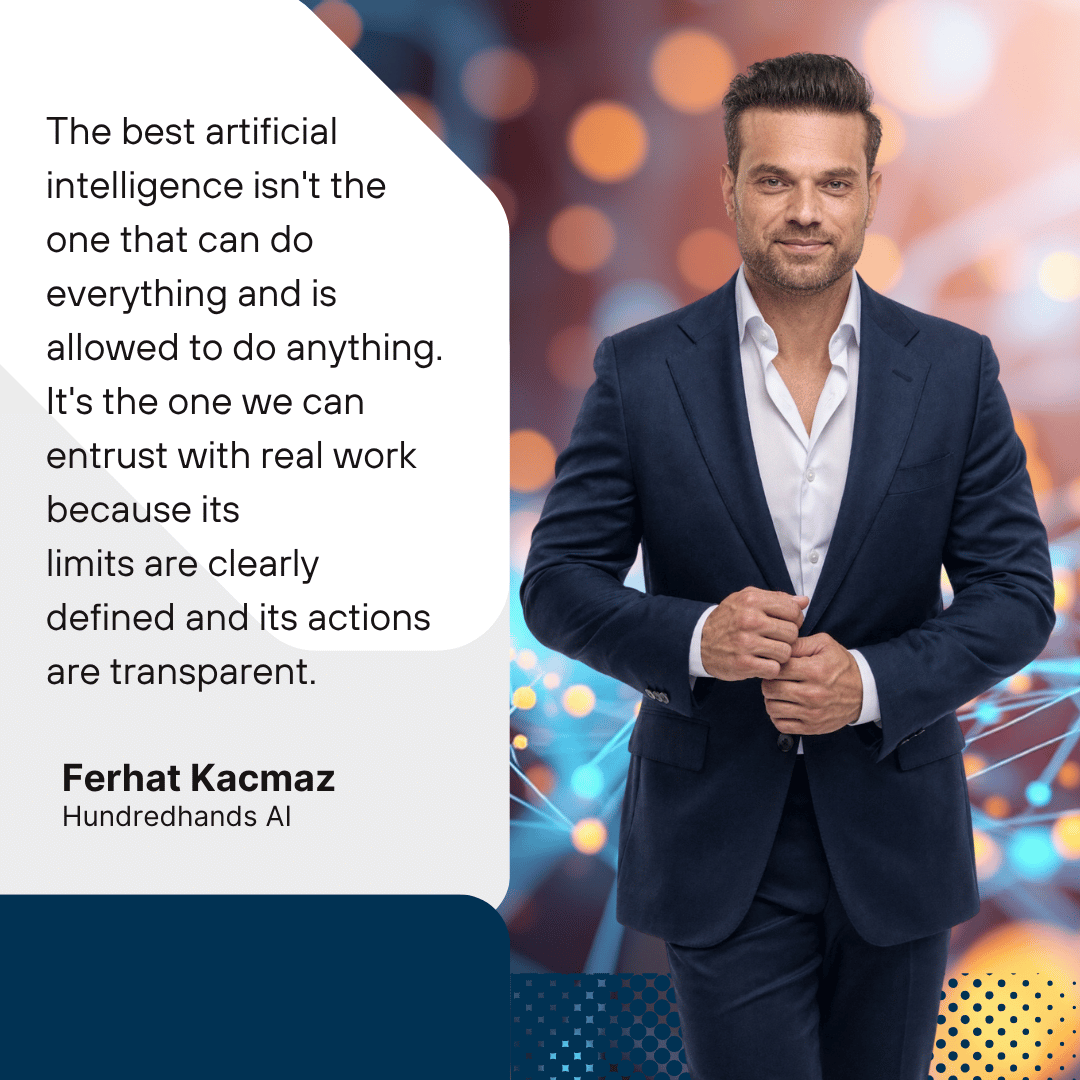
Conclusion: The Best AI Is Not the One That Is Allowed to Do Everything
Legal developments will often lag behind technological progress. A ruling from the Court of Justice of the European Union can take years. An AI model may change significantly within months. Nevertheless, the law is built around powerful principles. Those responsible for decisions must remain accountable. Organizations processing personal data must have a lawful basis for doing so. Companies using certain automated decisions affecting individuals must be able to provide meaningful explanations. And organizations deploying AI systems must manage the associated risks.
This is where the opportunity for HUNDREDHANDS lies. Ferhat Kacmaz wants to provide business owners with digital employees capable of performing real work. If his company consistently incorporates transparency, approvals, data protection, and effective controls into its products, it could create something considerably more valuable than maximum autonomy:
Reliable autonomy.
This may become the defining competitive advantage of the next generation of artificial intelligence. Business owners do not need digital employees that are allowed to do everything.They need digital employees they can trust with meaningful work, whose boundaries they understand, and whose actions they can monitor and control.
Dr. Rainer Schreiber – Adult Education Lecturer and Human Resources Consultant
Dr. Rainer Schreiber is a human resources consultant and freelance lecturer with an academic background in economics, specializing in finance, controlling, human resources, and vocational education. His professional interests include education, continuing professional development, career opportunities, demographic change, and economic policy. He publishes on human resources consulting, adult education, and developments in the labor market.
Contact – HUNDREDHANDS
HUNDREDHANDS is a product and brand of:
HUNDREDHANDS AI – FZCO
IFZA Properties, Premises DSO-IFZA
Dubai Silicon Oasis
Dubai, United Arab Emirates
Managing Director: Ferhat Kacmaz
Email: hello@hundredhands.io
Website: https://hundredhands.io/
About Ferhat Kacmaz
Ferhat Kacmaz is a SPIEGEL bestselling author, entrepreneur, and investor. For more than two decades, he has built businesses and explored how technological and economic changes can be identified early and translated into entrepreneurial opportunities. Today, Kacmaz lives in Dubai and works on international projects involving digital infrastructure, Bitcoin mining, wealth strategies, and artificial intelligence.
With HUNDREDHANDS, he is focusing on the next stage of workplace development: digital employees that do more than assist, taking on defined responsibilities within clearly established boundaries. His primary interest is not the short-term fascination with new AI models, but the larger question behind them: How will businesses, accountability, and human work change when artificial intelligence becomes an active part of an organization? His approach reflects a clear conviction: The future should not merely be observed. It must be understood, critically examined, and shaped responsibly.