
Ferhat Kacmaz, HUNDREDHANDS, and the New Division of Labor Between Humans and Artificial Intelligence
The numbers are significant enough to make business owners pay attention. The World Economic Forum expects approximately 170 million new jobs to be created worldwide by 2030, while around 92 million existing positions could be displaced. That would result in a net increase of 78 million jobs. An even more important figure is that approximately 39 percent of the skills required today could change or lose relevance by 2030.
The central question, therefore, is not whether work will still exist in the future. It is how work will change within individual companies—and whether those companies are prepared.
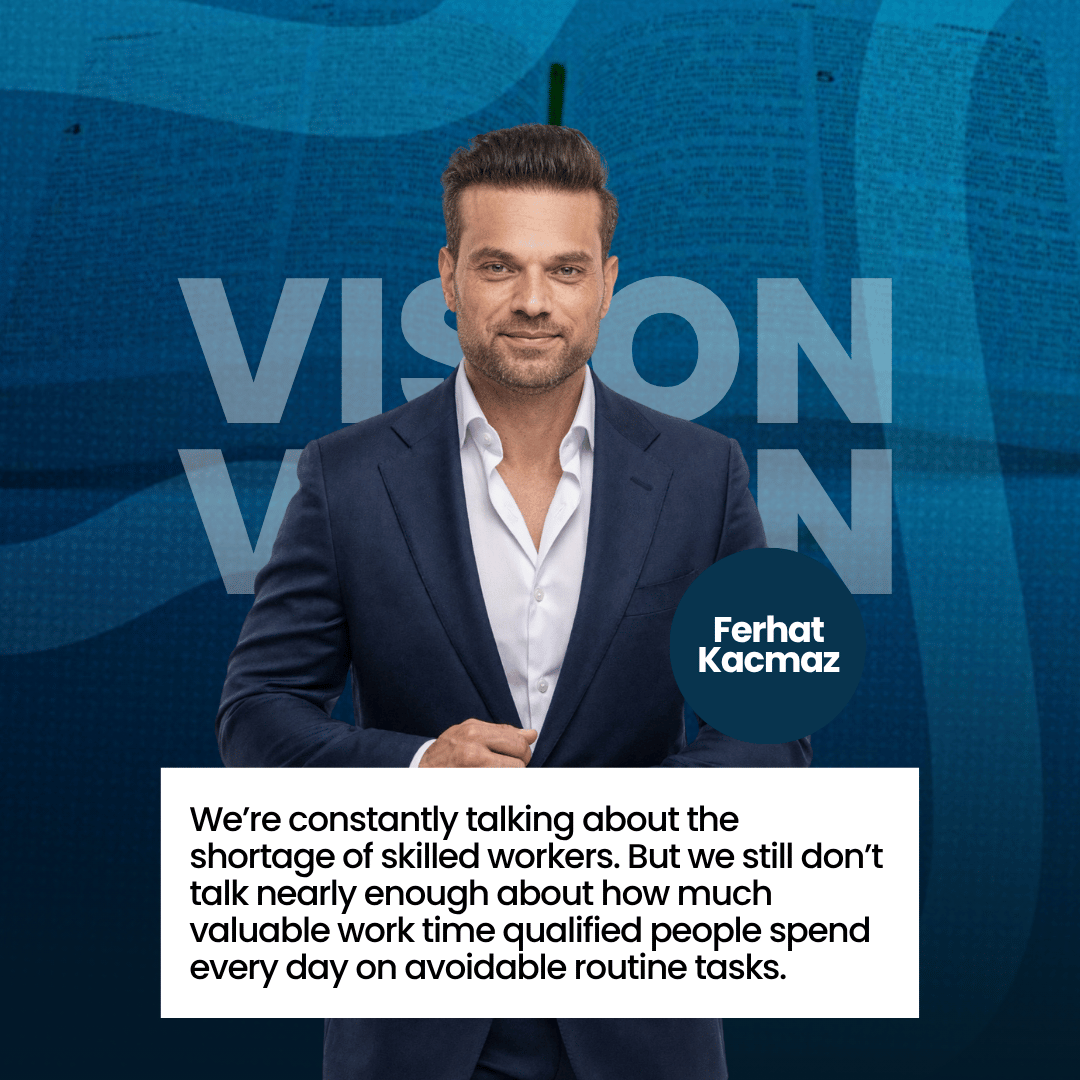
This is precisely where Ferhat Kacmaz and HUNDREDHANDS come in. His idea is straightforward: artificial intelligence should do more than occasionally assist employees. It should be capable of taking on specific responsibilities as a digital employee, thereby reducing the workload of human staff. For many business owners, this concept addresses a very real problem.
Small and Medium-Sized Businesses Need Support—and They Need It Now
Germany is simultaneously discussing a weak economy and a shortage of skilled workers. This may sound contradictory, but both challenges are real. According to figures from the Competence Centre for Securing Skilled Labour (KOFA), approximately 369,500 vacancies for qualified workers could not be filled in 2025. In mathematical terms, roughly one in three vacancies requiring qualified employees remained unfilled.
Small and medium-sized enterprises (SMEs) are particularly affected. A KOFA analysis concluded that 71.7 percent of Germany’s skilled labor shortage is concentrated in SMEs. Most recently, these businesses faced a calculated shortage of more than 281,000 qualified workers.
Despite the weak economy, Germany’s Federal Employment Agency also continues to identify significant labor market bottlenecks. For 2025, it identified 157 occupational categories experiencing skilled labor shortages. Approximately half of all reported vacancies were in occupations affected by these shortages. This is where the discussion about digital employees suddenly becomes highly practical. Many business owners do not want to reduce their workforce. They simply cannot find enough qualified people.
HUNDREDHANDS Addresses a Pressing Business Challenge
A skilled trades company has plenty of orders, but its office lacks administrative support. A law firm could serve more clients if qualified employees spent less time on routine tasks. A medium-sized business wants to grow, yet every new customer creates additional administrative work.
Quotations, emails, documentation, research, invoices, and appointment scheduling do not take care of themselves. Ferhat Kacmaz and HUNDREDHANDS focus precisely on these activities. A digital employee is intended to take over work that currently consumes valuable human capacity. Business owners should not have to become artificial intelligence specialists before they can benefit from the technology. This represents a fundamental difference between another AI tool and the concept behind HUNDREDHANDS.
A tool waits to be operated. A digital employee receives an assignment.
“What Can My Digital Employee Take Over?”
For business owners, this could become one of the most important management questions of the coming years. Not every new task must automatically require hiring another employee. Equally, not every activity that can be automated should immediately be taken away from a human worker. What matters is an intelligent division of responsibilities.
Ferhat Kacmaz expresses his perspective in particularly direct terms. Speaking about HUNDREDHANDS, he said:
“What we take away is the work no human wanted in the first place.”
His vision is clear: digital employees should primarily handle repetitive activities that consume time and prevent qualified professionals from focusing on more valuable responsibilities. Of course, this vision must prove itself in practice. Routine tasks are also part of professional development and learning processes.
Nevertheless, the economic logic is understandable. When a digital employee handles preparatory work, human employees gain more time for consulting, building relationships, creativity, supervision, and decision-making.
Labor Market Data Does Not Yet Indicate Widespread Job Destruction
Current research paints a considerably more nuanced picture than many headlines suggest. The Stanford Digital Economy Lab analyzed payroll data from millions of employees in the United States through June 2026.
The researchers found no evidence of widespread, economy-wide job displacement caused by artificial intelligence. At the same time, they identified warning signs. Among workers aged 22 to 25 in occupations particularly exposed to AI, employment was approximately 19 percent below the level that would have been expected if their employment had developed similarly to that of young workers in less AI-exposed occupations.
The researchers observed that the effect appeared primarily in new hiring. They explicitly emphasized that their data showed correlations rather than conclusive causal evidence that artificial intelligence alone was responsible for these developments.
For business owners, this is an important signal. Digital employees will change work. The question is how companies manage that transformation.
Job Transformation Is More Likely Than Complete Replacement
The International Labour Organization (ILO) also reaches a differentiated conclusion. Worldwide, approximately one in four workers is employed in an occupation exposed to generative artificial intelligence in some form. In high-income countries, that share reaches 34 percent.
Office and administrative occupations are particularly affected. The ILO’s central conclusion is that the transformation of occupations is more likely than their complete replacement. This finding aligns closely with the concept of digital employees. A sales representative, for example, remains important but may spend less time maintaining CRM records, conducting research, or preparing quotations.
An accounting or tax professional can concentrate more on reviewing documents and advising clients when digital systems handle preparatory work. Business owners gain greater visibility when information is already organized and ready for evaluation. The work remains, but its composition changes.
Klarna Demonstrates the Potential Scale of Productivity Gains
Payment services provider Klarna offers a particularly illustrative example. In its 2025 annual report, the company stated that its AI assistant handled 80 percent of all customer service chats. Since its introduction, the assistant had conducted approximately 31 million conversations.
Klarna estimated that this represented a workload equivalent to more than 700 full-time employees. The company reported approximately $39 million in cost savings for 2024. Even more interesting is its productivity development.
According to Klarna’s figures, average annual revenue per employee increased from approximately $344,000 in 2022 to around $1.24 million in 2025. Naturally, this increase cannot be attributed solely to artificial intelligence. Business growth, economies of scale, and other operational measures also contributed.
However, Klarna explicitly identifies AI as an important driver of efficiency. These figures illustrate the question business owners will increasingly face:
How much more can one person accomplish when digital employees take over part of the digital workload?
This Is Where HUNDREDHANDS Could Become a Game Changer
Large corporations can establish their own AI departments. They can employ software developers, data scientists, and consultants while investing millions in automation. Small and medium-sized businesses need a different approach. They require technology that reduces workloads without first introducing additional complexity.
Ferhat Kacmaz wants HUNDREDHANDS to close precisely this gap. Ideally, business owners should not have to concern themselves with which AI model performs a task or which technical architecture operates behind the scenes. They describe what needs to be done. The digital employee then handles defined tasks and refers matters back to human employees whenever judgment or approval is required. That is the decisive step. Artificial intelligence should become usable working capacity.
The Opportunity Is Particularly Visible in Skilled Trades
According to a recent KOFA analysis, nearly 100,000 vacancies in German skilled trades could not be filled in 2025. A plumbing company primarily needs qualified plumbers. However, when its existing team also spends hours coordinating appointments, preparing documentation, or completing administrative processes, a different problem emerges.
This is precisely the gap digital employees could help address. The idea is not to turn a digital employee into a plumber. The idea is to give the plumber more time to perform the work that only a qualified tradesperson can do. This principle can be applied across numerous industries. And that is where the broader social value may lie.
Trust Will Determine Success or Failure
Productivity alone is not enough. When a business owner assigns tasks to a digital employee, the system may need access to customer data, documents, and operational processes. That requires trust. The business owner must be able to understand which permissions the system has, which decisions it can prepare, and where human approval remains necessary. HUNDREDHANDS therefore positions its digital employee around control mechanisms and clearly defined boundaries.
Ferhat Kacmaz emphasizes:
“This is crucial for the future, because the most convincing AI will not necessarily be the one that can accomplish the most tasks independently.”
For business owners, the more valuable solution may be the one that provides meaningful relief while remaining transparent and controllable.
Ferhat Kacmaz Takes a Different View of the Future
Ferhat Kacmaz expects digital colleagues to become a much more normal part of business operations within the coming years. Exactly when this transformation will occur remains to be seen. However, the economic data suggests that business owners should not ignore the issue.
More than 369,000 calculated unfilled skilled-worker vacancies in Germany, almost three-quarters of the skilled labor shortage concentrated in SMEs, and technology already capable of handling substantial portions of digital routine work: these developments are converging. Together, they create a new entrepreneurial question:
Which tasks must my employees genuinely perform themselves, and where could a digital employee give them valuable time back?
This is precisely the question HUNDREDHANDS aims to help businesses answer.
The Future Does Not Demand Fear—It Demands Decisions
The figures do not point toward a world without work. They point toward a world in which work is distributed differently. Business owners can ignore this development. Or they can begin learning how human and digital employees can work together effectively.
Ferhat Kacmaz positions HUNDREDHANDS at this turning point. The greatest opportunity lies in no longer treating skilled labor shortages, increasing workloads, and technological change as three separate problems. They can be addressed together. Digital employees handle suitable tasks. Human employees gain time for responsibilities that require experience, personality, judgment, and accountability. Companies gain additional capacity.
If HUNDREDHANDS can reliably, transparently, and securely translate this promise into everyday operations for SMEs, that is where its true game-changing potential lies. A digital employee would no longer be an abstract vision of the future. It would become a practical answer to a question already confronting thousands of business owners: How can I handle more work when I cannot find enough people to do it?
Conclusion: Work Is Not Disappearing—It Is Being Redistributed
The central message of employment forecasts is neither entirely reassuring nor inherently threatening. It is more demanding than that. Work remains, but its value and composition are changing.
If millions of new jobs are created by 2030 while millions of others are displaced, this indicates a fundamental reorganization of the economy. Routine activities, preparatory tasks, and repetitive digital work will increasingly be handled by artificial intelligence. Human work will become more valuable in areas where experience, judgment, responsibility, relationships, and trust are essential. This is where Ferhat Kacmaz and HUNDREDHANDS come in.
The digital employee is intended to provide companies with additional capacity while relieving human employees of activities that consume time and restrict growth. The crucial challenge will be to shape this new division of labor deliberately. For business owners, the central question is no longer simply: How many jobs will disappear?
Instead, it is: Which responsibilities should people continue to perform themselves, and which can digital employees handle reliably? Companies that answer this question early may be better positioned to address labor shortages, improve productivity, and create new opportunities for meaningful human work. The future of work will not be decided by choosing between humans and machines. It will depend on how intelligently humans and digital employees work together. And that is the strategic potential of HUNDREDHANDS: not to eliminate work, but to redistribute it—with the goal of making businesses more productive and human work more valuable.
Dr. Rainer Schreiber – Adult Education Lecturer and Human Resources Consultant
Dr. Rainer Schreiber is a human resources consultant and freelance lecturer with an academic background in economics, specializing in finance, controlling, human resources, and vocational education.
His professional interests include adult education, continuing professional development, career opportunities, demographic change, and economic policy.
Contact – HUNDREDHANDS
HUNDREDHANDS AI – FZCO
IFZA Properties, Premises DSO-IFZA
Dubai Silicon Oasis
Dubai, United Arab Emirates
Managing Director: Ferhat Kacmaz
Email: hello@hundredhands.io
Website: https://hundredhands.io/
About Ferhat Kacmaz
Ferhat Kacmaz is a SPIEGEL bestselling author, entrepreneur, and investor. For more than two decades, he has built businesses and explored how technological and economic transformations can be identified early and translated into entrepreneurial opportunities.
Today, Kacmaz lives in Dubai and works on international projects involving digital infrastructure, Bitcoin mining, wealth strategies, and artificial intelligence. With HUNDREDHANDS, he is focusing on the next stage of workplace development: digital employees that do more than assist, taking on defined responsibilities within clearly established boundaries.
His primary interest is not the short-term fascination with new AI models, but the larger question behind them: How will businesses, accountability, and human work change when artificial intelligence becomes an active part of an organization? His approach is based on a clear conviction: The future should not merely be observed. It must be understood, critically examined, and shaped responsibly.